The Canadian Nuclear Isotope Council concludes a landmark training course for Latin American delegates, marking Canada’s first contribution to the IAEA’s Rays of Hope initiative
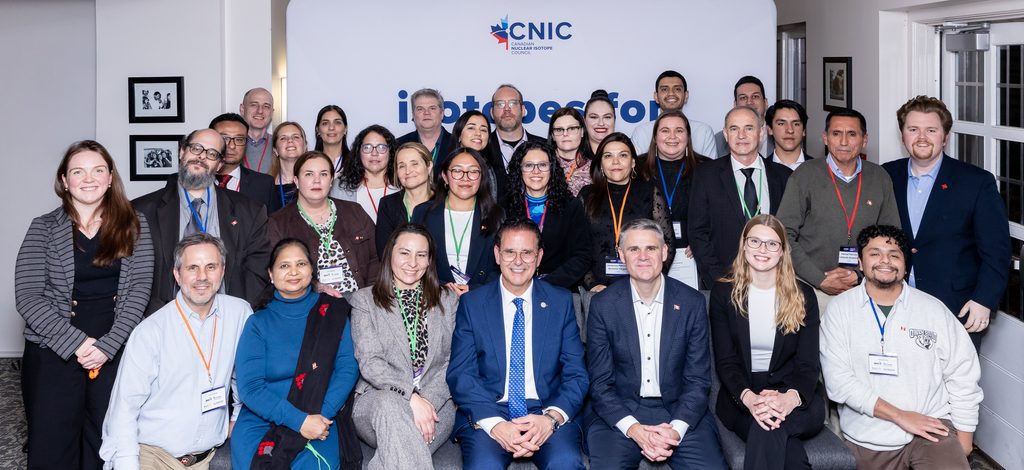
Toronto, Ontario – November 16, 2026 – From November 8-14, 2026, the Canadian Nuclear Isotope Council (CNIC) hosted a delegation of 25 leaders from Latin America for a weeklong course on the production, quality control, and regulatory compliance of medical radioisotopes.
The course, which marked Canada’s first contribution to the International Atomic Energy Agency’s (IAEA) Rays of Hope initiative, was hosted at Bruce Power in Tiverton, Ontario, and McMaster University and AtomVie Global Radiopharma in Hamilton, Ontario.
Rays of Hope is a global initiative led by the IAEA that supports projects to expand access to cancer care and critical radiotherapy infrastructure in low- and middle-income countries (LMICs), where the burden of cancer is greatest. As a long-standing leader in the production of medical isotopes, Canada’s isotope sector has a significant opportunity and responsibility to share its knowledge to support patients in countries around the world.
While the Government of Canada has not yet formally supported Rays of Hope, the CNIC, as the voice of Canada’s isotope industry, convened several leading organizations from across the Canadian isotope supply chain to deliver this training program to leaders from Argentina, Brazil, Chile, and Mexico. Specially designed to enhance professional capacity, share best practices, and support increased access to life-saving cancer care, the training program demonstrates Canadian isotope leadership in action and marks an important first step in Canada’s contribution to closing the gap in global cancer care.
The development of the program followed a February 2026 meeting between CNIC Chair James Scongack and IAEA Director-General Rafael Mariano Grossi, during which they established an ambitious goal of delivering this training program before the end of the year. In the months that followed, the CNIC, in collaboration with the IAEA and industry partners, intensified planning and engagement to bring the program to life.
Throughout the training course, participants engaged with over 70 industry, academic, and clinical leaders from across Canada. Training session topics ranged from radiation safety, radiation biology, and health physics to the practical clinical application of theranostics and isotope production.
Delegates also received exclusive tours of Bruce Power’s site, including its new on-site hot cell facility, McMaster University’s Centre for Advanced Nuclear Systems and nuclear medicine department, and AtomVie Global Radiopharma’s state-of-the-art CDMO facilities.
This first-of-its-kind program culminated in a reception hosted at McMaster University, bringing together training delegates, academic and clinical experts, industry leaders, and elected officials in celebration of the success of the training program. Following virtual remarks from IAEA Director-General Rafael Mariano Grossi and Member of Parliament John-Paul Danko, participation certificates were presented to all 25 delegates by CNIC Chair James Scongack and Member of Provincial Parliament Rudy Cuzzetto, Parliamentary Assistant to Ontario’s Minister of Energy and Mines.
“As demand grows, strengthening expertise is essential to scaling up assistance. Sustained support from our partners, such as Canada, will directly enable the IAEA to meet the growing need for life-saving cancer care,” said Rafael Mariano Grossi, Director-General of the International Atomic Energy Agency. “This is atoms for peace in action.”
“Canada has been a global leader in the production of medical isotopes for decades. By supporting the IAEA’s Rays of Hope initiative, the CNIC and our industry partners are proud to share our knowledge to support access to cancer care in Latin America,” said James Scongack, Chair of the CNIC. “By expanding capacity in low- and middle-income countries, we can extend our reach and provide hope to patients and families globally when they need it most.”
This historic training program would not have been possible without the financial support of four title sponsors, Bruce Power, BWXT Medical, CANDU Energy Inc., and Laurentis Energy Partners, and additional financial support from Nordion, as well as in-kind training facility support from McMaster University and AtomVie Global Radiopharma Inc.
While this historic program marks Canada’s first contribution to Rays of Hope, the CNIC is committed to ensuring it won’t be Canada’s last and looks forward to continuing collaboration with the delegates and the IAEA into the future.
About the Canadian Nuclear Isotope Council:
The Canadian Nuclear Isotope Council (CNIC) is an independent, not-for-profit advocacy and member services organization. The CNIC supports over 130 members from across science, academia, healthcare, and nuclear-sector organizations dedicated to maintaining Canada’s position as a global leader in the production of life-saving isotopes. As the voice of Canada’s isotope industry, the CNIC raises awareness and advocates for long-term policies that support Canadian isotope innovation, offering hope to patients globally.
To learn more about the CNIC, visit www.CanadianIsotopes.ca and follow us on Facebook, X, and LinkedIn, or please contact:
Evan Cameron
Manager, Public Affairs and Communications
Canadian Nuclear Isotope Council
evan.cameron@canadianisotopes.ca