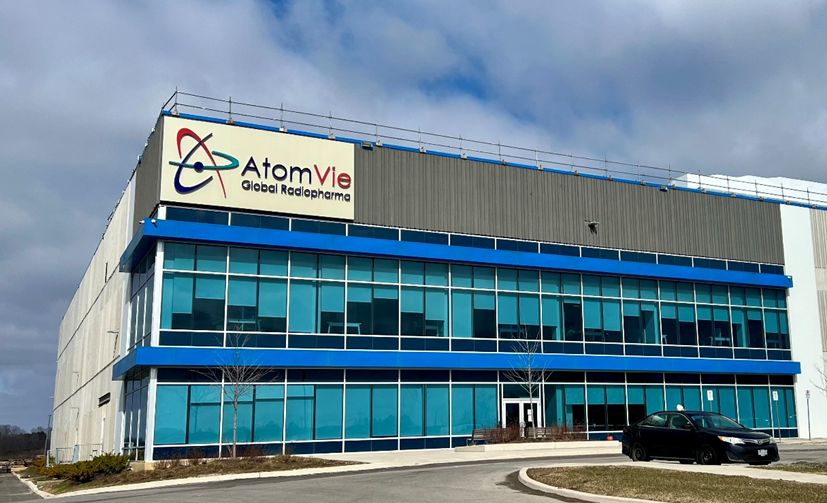
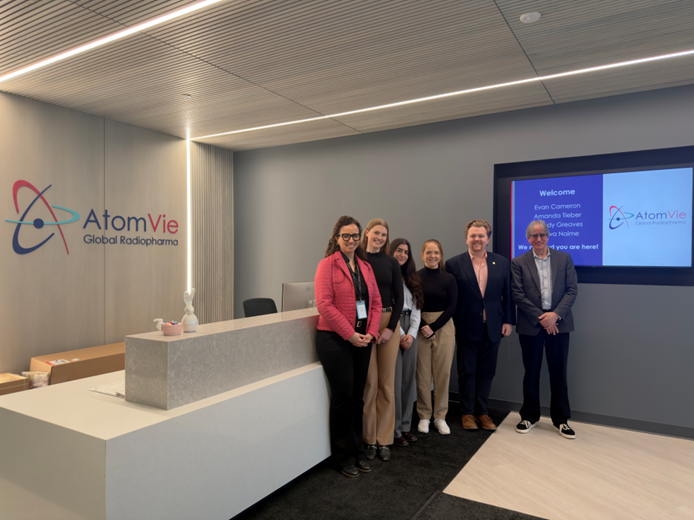
The CNIC team recently visited its member, AtomVie Global Radiopharma’s (AtomVie’s) new Hamilton facility to get a closer look at the company’s next phase of growth. AtomVie is a global leading radiopharmaceutical Contract Development and Manufacturing Organization (CDMO), which emerged as a spinout of the Centre for Probe Development and Commercialization (CPDC), a McMaster University-founded Centre of Excellence.
The new $160 million facility reflects AtomVie’s remarkable growth. This purpose-built state-of-the-art facility totals 72,300 square feet and supports at least a tenfold increase in production capacity relative to its capacity at the McMaster facility. This site will offer dedicated infrastructure for expanding GMP manufacturing needs and host a future space for customized high throughout needs. Once complete, the site will stand out as the only single-site radiopharmaceutical CDMO of its size in North America, a distinction that reflects both the scale of the investment and the company’s ambition to build long-term Canadian manufacturing capacity.
What stood out during the visit was not just the size of the facility, but how deliberately it has been designed around radiopharmaceutical production needs. The site is a state-of-the-art, EU Annex 1-compliant facility, with commissioning activities commenced in Q2 2026. It includes multiple cleanrooms with custom-designed equipment, reflecting a production model built around sterility, flexibility, and modern radiopharmaceutical workflows. The innovative solutions incorporated throughout the site to support sterile GMP manufacturing are evident, alongside in-house microbiology laboratories that allow critical testing functions to remain internal – another unique feature of this new facility.
Throughout the visit, it became clear that the company’s value proposition extends beyond infrastructure to include the depth of technical and operational expertise it brings to radiopharmaceutical development and manufacturing. This encompasses capabilities in analytical method and process development, phase‑appropriate qualification and validation, as well as GMP manufacturing for clinical and commercial supply for global distribution, and the associated logistics required to support time‑sensitive radiopharmaceutical programs. Together, this expertise helps explain how AtomVie has built a strong position in such a highly specialized and regulated field.
The Hamilton facility also reflects a phased growth strategy. This forward-looking design gives the company room to grow as demand evolves, while ensuring the site can support both present clinical and research needs and future commercial-scale manufacturing. Meanwhile, when AtomVie decommissions its McMaster campus facility, they will transition toward this new Hamilton site as the company’s central operating hub.
It is also important to recognize AtomVie’s substantial achievements to date. The company has supported more than 60 development and tech transfer programs with a significant proportion of them reaching the clinic, manufactured more than 830 cGMP batches, and shipped more than 4,000 cGMP doses, with more than 99% dose delivery for successful patient administration. Through this expertise, AtomVie has built a track record of having worked on 50% of current radioligand therapy assets in Phase II, Phase III, and commercial stages.
Location is another intentional part of the AtomVie story. Situated next to Hamilton International Airport, with quick access to Pearson International Airport and the U.S. border, the facility is well positioned for time-sensitive distribution. AtomVie already ships to 28 countries across six continents within 72 hours or less, and the potential future ability to ship directly out of Hamilton may further strengthen that logistics advantage over time.
This new facility is the kind of investment that can bring more activity into the area and contribute to the region’s growing role in advanced life sciences manufacturing. It is also expected to create 70 new highly skilled jobs bringing AtomVie’s employees to over 200 by the end of 2026, further strengthening Hamilton’s role as a growing hub for radiopharmaceutical manufacturing. Even the smaller details throughout the facility reflected a strong sense of place. For example, each meeting room is named after a Hamilton waterfall honoring it birthplace’s heritage since Hamilton is the waterfall capital of the world, a thoughtful reminder that even as AtomVie scales globally, it is also building something firmly rooted in its local community.
We sincerely thank the AtomVie team for hosting us and for sharing a closer look at this important next step for the company and for the Canadian isotope ecosystem as a whole.
To learn more about AtomVie Global Radiopharma visit www.atomvie.com